
A shared Outlook calendar that won’t show up is almost always one of nine concrete issues. This guide walks through each cause and the exact fix for Classic Outlook, New Outlook (2024+), and Outlook on the web. Two of the nine fixes are new for 2025/2026 — the Shared Calendar Improvements toggle and the Classic vs New Outlook split.
| Quick answer — the top 3 causes: Most cases trace back to one of three things: (1) the sharing invitation was never accepted, (2) the calendar’s checkbox is unticked in the navigation pane, or (3) your permission level is below Reviewer. If the calendar disappeared after an Outlook update in 2025 or 2026, jump straight to Fix 4 (Shared Calendar Improvements toggle). If you’re on New Outlook, see Fix 6. |
30-second diagnostic
Match the symptom to the most likely cause and jump straight to the right fix.
| Symptom | Likely cause | Go to |
| Calendar doesn’t show at all | Invitation not accepted or checkbox unticked | Fix 1–2 |
| Visible but empty | Insufficient permissions (Reviewer minimum) | Fix 3 |
| Was visible — disappeared after update | Shared Calendar Improvements toggle [NEW] | Fix 4 |
| Problem only in New Outlook | Different steps in Classic vs New [NEW] | Fix 6 |
| Error when adding the calendar | Cache / sync issue | Fix 5 |
| Problem only in OWA | Browser cache | Fix 9 |
What you’ll fix in this guide
- Sharing invitation not accepted
- Calendar checkbox unticked in the navigation pane
- Insufficient permissions — Reviewer is the minimum
- Disable “Shared Calendar Improvements” toggle [NEW 2025/2026]
- Sync and cache issues across Classic, New, and OWA
- Classic Outlook vs New Outlook — different steps [NEW 2025/2026]
- Organization policies — Exchange Online and EWS
- Delegation vs Sharing — different mechanisms
- Clear the browser cache (OWA only)
The only M365 enterprise calendar
… that never leaves your cloud. Data stays in your Azure, under your control.
Fix 1 — Sharing invitation not accepted
Most “calendar not showing” cases come down to a pending invitation that was never accepted. Check your inbox — including Spam/Junk — for an email from the calendar owner. The subject usually reads “I’d like to share my calendar with you.”
In Classic Outlook (Windows / Mac)
- Open the invitation email.
- Click “Accept and view calendar” (Windows) or “Accept” (Mac).
- The calendar is added under “Other Calendars” or “Shared Calendars.”
In New Outlook (2024+)
- If no Accept button appears, click “Add to my calendars” instead.
- Open the invitation in your inbox.
- Click “Accept” — New Outlook adds the calendar under “Other people’s calendars” automatically.
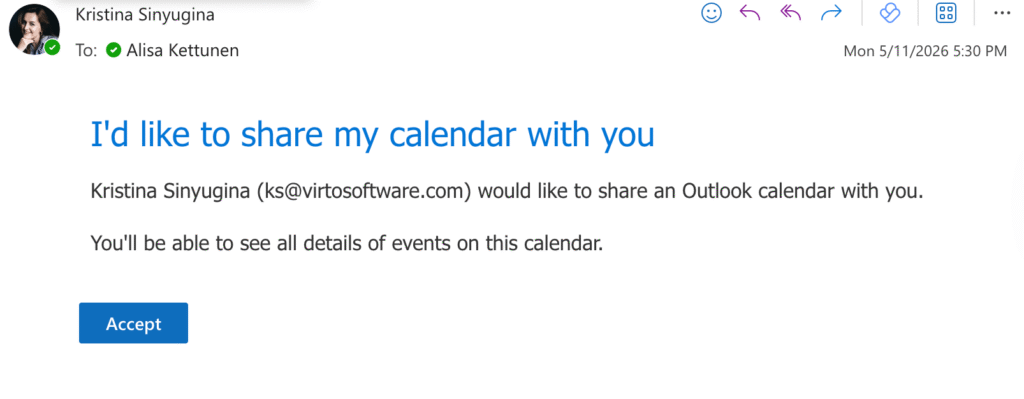
Pic. 1. Accepting a shared calendar invitation in New Outlook (2024+).
In Outlook on the web (OWA)
- Open the invitation email.
- Click “Accept” — OWA prompts you to choose a category color and group.
- Confirm — the calendar appears in your left sidebar.
If you can’t find the invitation, ask the calendar owner to resend it. Old invitations can expire and may need to be reissued.
Pre-flight check
Before resending the invitation, confirm that the owner used your primary SMTP address. Aliases and guest-user identities (UPN ≠ primary SMTP) are the most common reason an accepted invitation still doesn’t materialize as a visible calendar.
Fix 2 — Calendar checkbox unticked in the navigation pane
Even after accepting an invitation, the calendar won’t appear in your view until you tick the checkbox next to its name. This is the single most common cause for “I accepted it but still can’t see it.”
- Classic Outlook (Windows): In Calendar view, look at the left navigation pane under “People’s Calendars” (or “Shared Calendars”). Tick the box next to the calendar name.
- Classic Outlook (Mac): Look under “Shared Calendars” in the left sidebar. Tick the checkbox next to the calendar.
- New Outlook (2024+): The group is renamed — look under “Other people’s calendars” rather than “People’s Calendars.” Tick the checkbox; the calendar will overlay your own.
- OWA: Find the calendar under “People’s calendars” in the left pane. Click the circle next to it to enable display.
If the calendar is missing from the list entirely, jump to Fix 1.
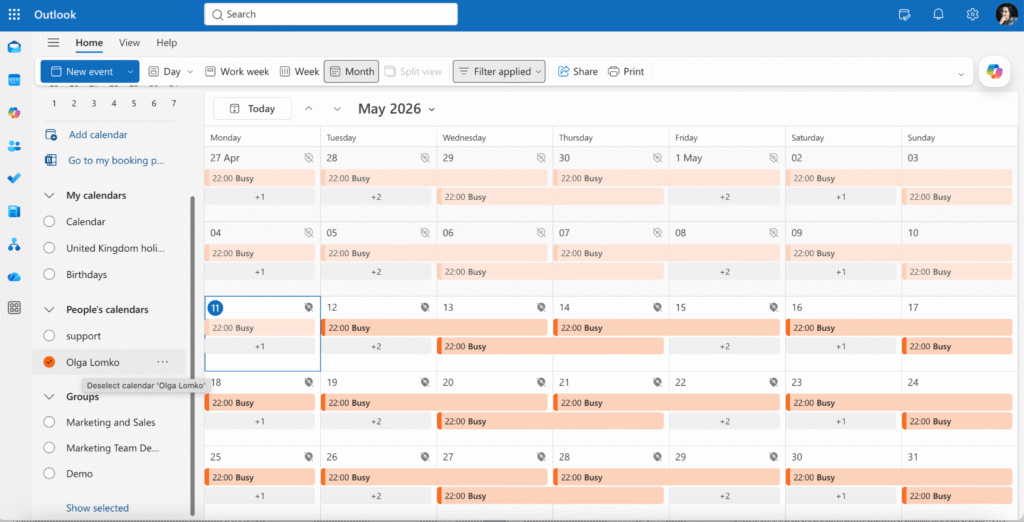
Pic. 2. Ticking the shared-calendar checkbox under “Other people’s calendars” in New Outlook.
Fix 3 — Insufficient permissions: Reviewer is the minimum
The owner may have shared the calendar but granted only “Free/Busy” or “Limited details,” in which case you’ll see an outline but no event details. To view full event details, you need at least Reviewer permission.
| Permission level | What you can see |
| None | Nothing — calendar will not appear |
| Free/Busy time | Only blocks of busy time |
| Limited details | Subjects but not body |
| Reviewer ← minimum for full visibility | Full event details (read-only) |
| Author | View + create events |
| Editor | View + create + edit + delete |
| Delegate | Editor + respond to meetings on the owner’s behalf |
Ask the calendar owner to verify your permission level:
- Classic Outlook (Windows): right-click the calendar → Properties → Permissions tab → confirm your name appears with Reviewer or higher.
- Classic Outlook (Mac): right-click the calendar → Sharing Permissions → confirm the dropdown next to your name shows Reviewer or higher.
- New Outlook / OWA: Calendar settings → Shared calendars → review the permission level listed for each user.
If your level is below Reviewer, ask the owner to upgrade it. Permission changes can take 15–60 minutes to propagate.
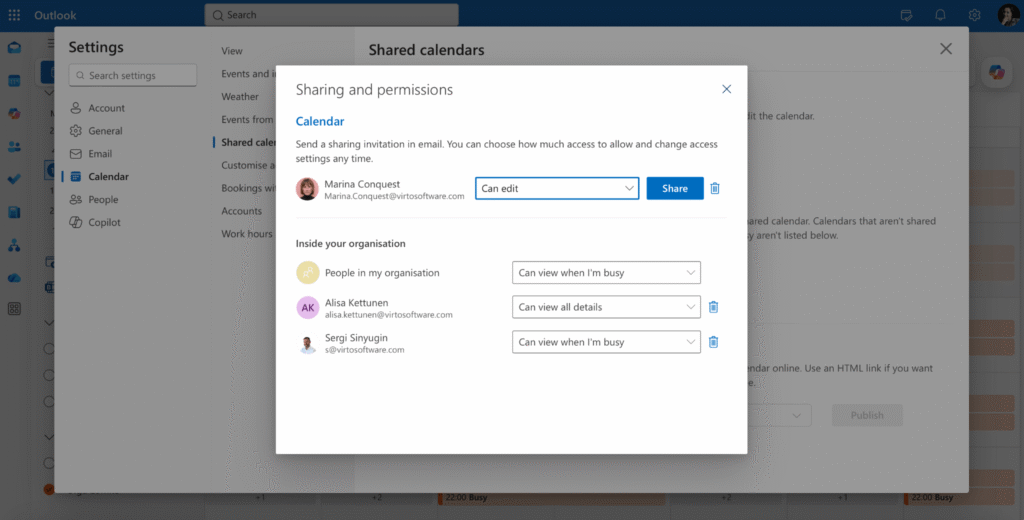
Pic. 3. Setting at least Reviewer permission in Calendar Properties → Permissions.
Fix 4 — Disable the “Shared Calendar Improvements” toggle [NEW 2025/2026]
| Why this fix matters in 2026: Microsoft enabled “Shared Calendar Improvements” by default in 2024–2025 builds of Classic Outlook for Windows. For many users — especially in tenants with delegation or large shared mailboxes — the new sync model causes shared calendars to stop rendering, even when permissions and acceptance are correct. Reverting to the legacy sync path is the official Microsoft workaround. |
Exact path to disable (Classic Outlook for Windows only)
- File → Account Settings → Account Settings.
- Select your account and click “Change.”
- Click “More Settings.”
- Open the Advanced tab.
- Uncheck “Turn on shared calendar improvements.”
- Click OK → Next → Finish.
- Close Outlook completely and reopen.
Outlook rebuilds the shared calendar connection on the next sync. The calendar typically reappears within a few minutes.
Why it happens
The new sync mechanism uses REST APIs rather than legacy MAPI calls. In edge cases — cross-tenant sharing, very large calendars, delegate access, certain group policies — the REST path can fail silently and the calendar simply doesn’t render. Reverting to the legacy path bypasses the failure.
Where the toggle is available
- Classic Outlook for Windows: available (path above).
- New Outlook for Windows: not available — uses a different sync architecture (see Fix 6).
- Outlook for Mac: not available.
- OWA: not applicable.
If the toggle isn’t visible, your build is too old or your tenant administrator has hidden it.
If the toggle is greyed out (Group Policy)
Some IT admins enforce the new sync model via Group Policy. If the checkbox is greyed out, ask your admin to verify the policy “Turn on shared calendar improvements” under User Configuration → Administrative Templates → Microsoft Outlook → Account Settings → Exchange. The admin can either disable enforcement or set it to Not Configured so individual users can opt out.
Fix 5 — Sync and cache issues
If the calendar shows up briefly then disappears, or stays empty for hours, you likely have a sync problem. The fix is different on each platform.
Classic Outlook (Windows)
- Send/Receive tab → click “Send/Receive All Folders” (or press F9).
- If that doesn’t help: File → Account Settings → select your account → Change → uncheck “Use Cached Exchange Mode” → Next → Finish → restart Outlook.
- If still broken, rebuild the OST: close Outlook, navigate to %localappdata%\Microsoft\Outlook, rename outlook.ost to outlook_old.ost, then restart Outlook. A fresh OST is created.
Classic Outlook (Mac)
- Right-click the shared calendar → Sync.
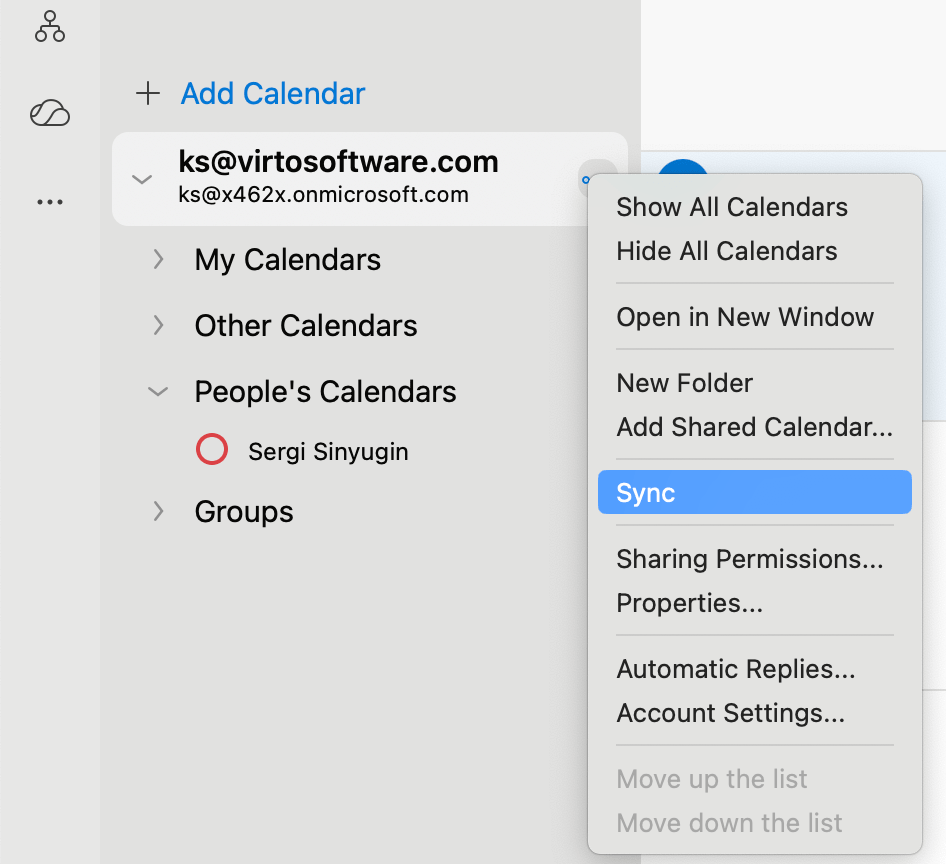
Pic. 4. Syncing shared calendar in Outlook for Mac.
- Still broken? Reset the account via Outlook → Settings → Accounts → Click on a chosen account, then click Manage → Reset Account.
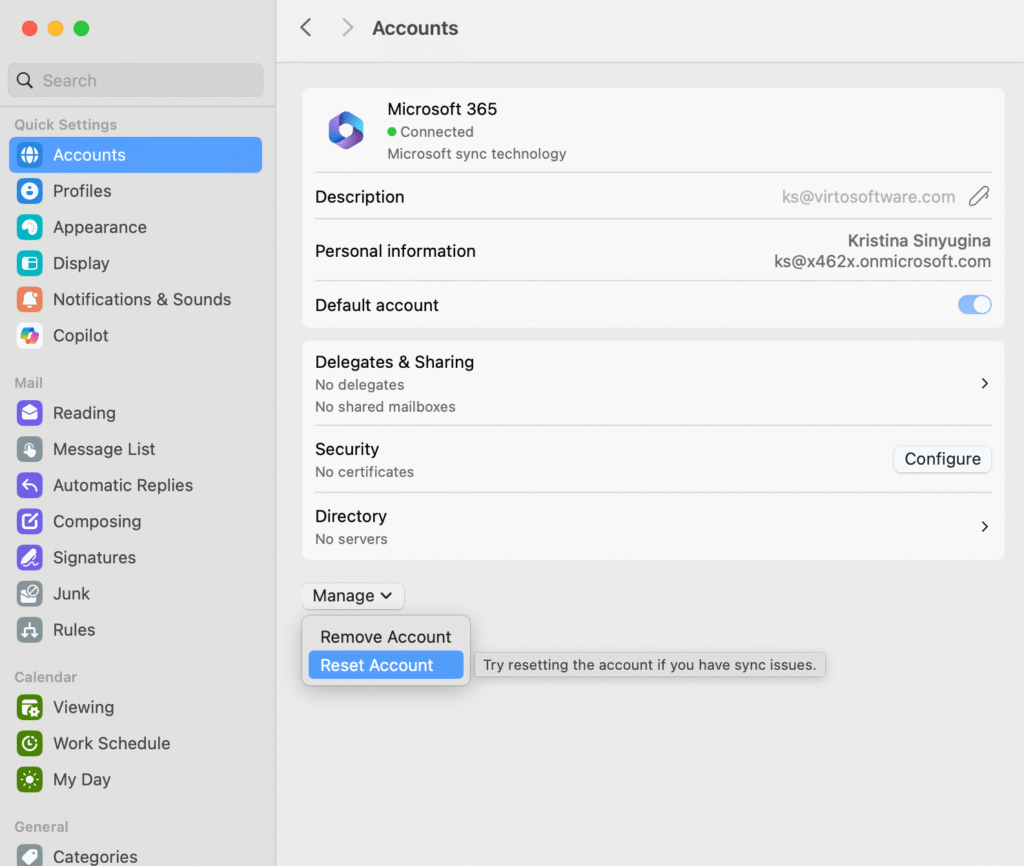
Pic. 5. Resetting the account in Outlook for Mac.
New Outlook (2024+)
- Settings → General → Storage → click “Clear local storage” to force a full resync.
- Restart New Outlook.
- If the calendar still doesn’t load, remove and re-add your account: Settings → Accounts.
Tip: New Outlook keeps a small local cache only — most of its sync state lives server-side, so re-adding the account almost always clears stale data when “Clear local storage” doesn’t.
Outlook on the web (OWA)
- Refresh the page (Ctrl+F5).
- Sign out, then sign back in.
- If that fails, jump to Fix 9 — clear the browser cache.
Fix 6 — Classic Outlook vs New Outlook: different steps [NEW 2025/2026]
Microsoft is rolling all users from Classic Outlook to New Outlook between 2024 and 2026. The two apps look similar but the underlying engine is completely different — and the shared-calendar workflow is not the same. Following Classic Outlook steps inside New Outlook (or vice versa) is one of the top reasons users think the feature is “broken.”
Side-by-side comparison
| Task | Classic Outlook (Windows) | New Outlook (2024+) |
| Add a shared calendar | File → Account Settings → Add Calendar | Calendar → Add calendar → Add from directory |
| Where the calendar lives | “People’s Calendars” group | “Other people’s calendars” group |
| Toggle visibility | Tick checkbox next to name | Tick checkbox next to name (different location) |
| Shared Calendar Improvements | File → Account Settings → Advanced → toggle | Not available — uses a different sync mechanism |
| Force resync | Send/Receive All Folders (F9) | Settings → General → Storage → Clear local storage |
| Manage permissions | Right-click calendar → Properties → Permissions | Calendar → Sharing and permissions |
How to tell which version you’re running
- Classic Outlook: File menu in the top-left, ribbon with tabs (Home, Send/Receive, etc.).
- New Outlook: no File menu, simplified ribbon, and a “New Outlook” toggle in the upper-right.
If you’re on New Outlook but the troubleshooting documentation you found refers to Classic UI elements, switch back to Classic temporarily: toggle “New Outlook” off in the top-right. Microsoft preserves this fallback through 2026.
Fix 7 — Organization policies (IT Admin / Exchange Online)
In corporate tenants, calendar sharing is often controlled by Exchange Online sharing policies. Even if every user-side setting is correct, the policy may block calendar visibility. Ask your IT admin to verify the four items below.
- Sharing policy enabled for your domain:
Run Get-SharingPolicy | Format-List Name,Domains,Enabled and confirm your domain (or “*”) is listed and the policy is Enabled.
- Calendar sharing permission level:
Run Get-MailboxFolderPermission -Identity “owner@domain.com:\Calendar” and confirm the recipient is listed with at least Reviewer.
- EWS access enabled for the recipient mailbox:
Run Get-CASMailbox -Identity recipient@domain.com | Format-List EwsEnabled. If False, shared calendars in Classic Outlook will not sync.
- Free/Busy access between tenants (cross-tenant sharing only):
Run Get-OrganizationRelationship | Format-List Name,Enabled,FreeBusyAccessEnabled.
If a policy was recently changed, allow 1–4 hours for changes to propagate through Active Directory.
Cross-tenant sharing checklist
When the calendar owner is in a different Microsoft 365 tenant, three additional conditions must hold: (1) both tenants must have an Organization Relationship configured with Free/Busy enabled, (2) the recipient tenant must allow inbound sharing in its Sharing Policy, and (3) modern authentication must be enabled on both sides. A single missing piece will make the calendar invisible even if all user-side settings are correct.
Fix 8 — Delegation vs Sharing: different mechanisms
Microsoft 365 has two distinct ways to grant someone access to a calendar, and confusing them is a common source of “not showing” complaints.
| Mechanism | What it does | When to use |
| Sharing | Recipient sees the calendar in their list, read or read/write | Coworkers, team visibility |
| Delegation | Recipient acts on the owner’s behalf — accepts meetings, sends mail | Executive assistants, deputies |
Key practical differences
- Sharing supports many recipients; Delegation usually a handful.
- Delegates can send meeting responses on behalf of the owner; shared users cannot.
- Delegation requires the owner to enable “Send meeting requests and responses only to my delegates” for routing to work as expected.
- Removing a Delegate does not automatically remove their calendar visibility — Sharing permissions may need to be removed separately.
If a recipient was set up as a Delegate but the calendar isn’t showing, ask the owner to additionally add explicit Sharing permission (Properties → Permissions → Add). A common pitfall is assuming Delegation alone makes the calendar appear in the delegate’s navigation pane — it does not. The delegate still needs to open the calendar through File → Open & Export → Other User’s Folder in Classic Outlook (or People’s Calendars).
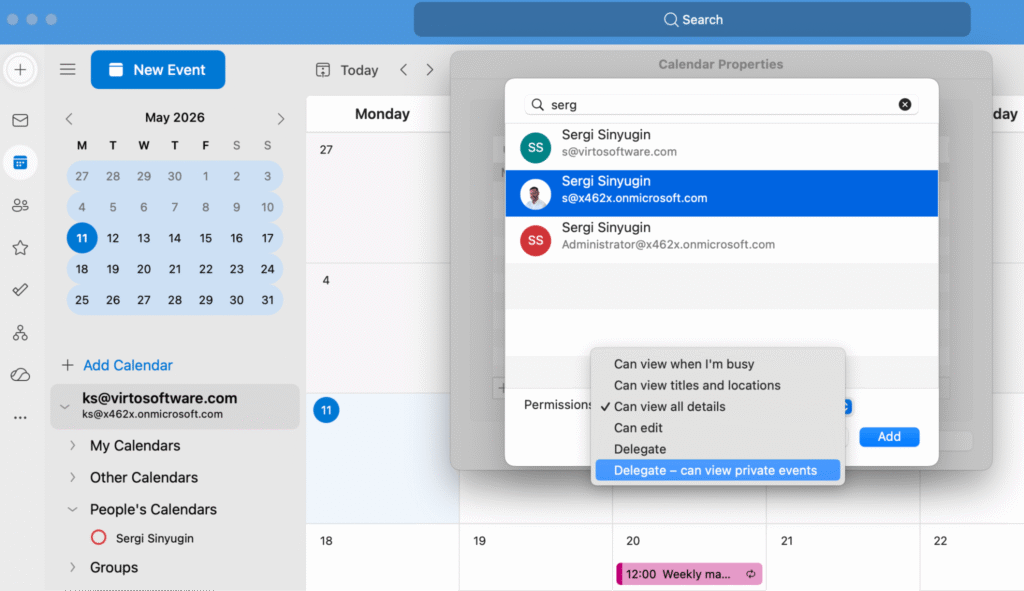
Pic. 6. Delegate Permissions in Outlook (different mechanism from standard Sharing).
Fix 9 — Clear the browser cache (OWA only)
Browser cache corruption is the most common cause of OWA-specific calendar issues. Clear cache and cookies for outlook.office.com.
| Browser | Shortcut | Path |
| Chrome / Edge | Ctrl+Shift+Delete | Settings → Privacy → Clear browsing data |
| Firefox | Ctrl+Shift+Delete | Settings → Privacy → Cookies and Site Data → Clear Data |
| Safari (Mac) | Cmd+Option+E (cache only) | Safari → Settings → Privacy → Manage Website Data |
Steps
- Press Ctrl+Shift+Delete (Cmd+Shift+Delete on Mac).
- Select “Cookies and other site data” and “Cached images and files.”
- Time range: All time.
- Click “Clear data.”
- Close all browser windows and reopen.
- Sign back into outlook.office.com.
If clearing the cache doesn’t help, try a private/incognito window. If the calendar shows up there, a browser extension is interfering.
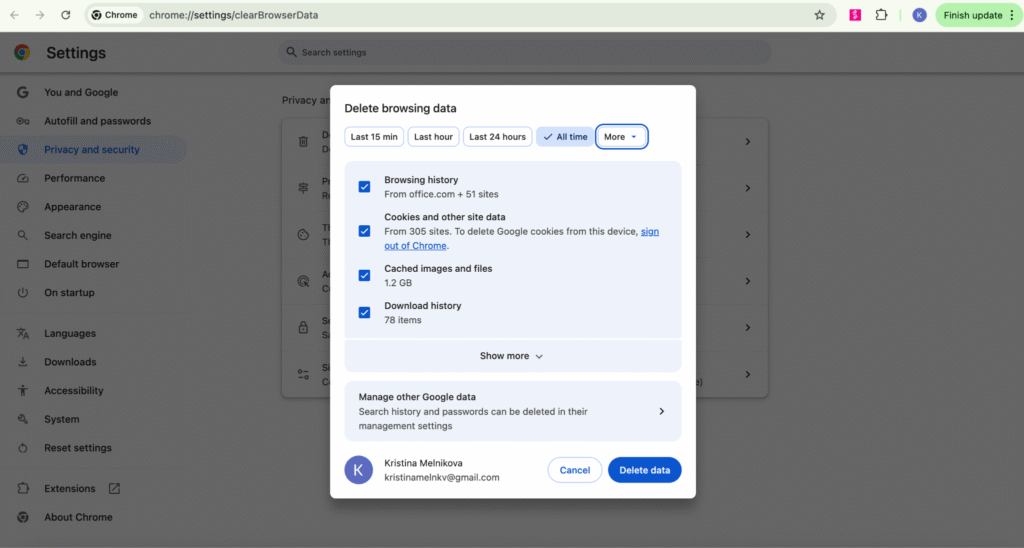
Pic. 7. Clearing cookies and cached data for outlook.office.com (Chrome / Edge).
Quick checklist — all 9 fixes
Use this list as a fast pass before escalating to IT.
- Accept the sharing invitation.
- Tick the checkbox in the navigation pane.
- Verify permission level — Reviewer minimum.
- Disable the “Shared Calendar Improvements” toggle (Classic Outlook for Windows).
- Clear Outlook cache, rebuild the OST, or re-add the account.
- Confirm Classic vs New Outlook and use the matching steps.
- Ask IT to check Exchange sharing policy and EWS access.
- Confirm whether access was granted via Sharing or Delegation.
- Clear the browser cache (OWA).
When standard fixes aren’t enough → Virto Calendar
If you’ve worked through all nine fixes and the shared calendar still won’t render reliably, you’re likely running into a structural limitation of the native Outlook sync model — not a configuration mistake. This is common in cross-tenant sharing, very large team calendars, and environments where users need to overlay calendars from sources outside Exchange (SharePoint, Planner, iCal, Google).
Virto Calendar App for Microsoft 365 runs alongside Outlook and Teams, not as a replacement. Existing Exchange calendars stay where they are; Virto adds an overlay engine that connects to multiple data sources and renders them in a single unified view, with its own sync mechanism that sidesteps the Classic-vs-New Outlook split entirely.
Why this matters for “calendar not showing” cases
- Independent sync. Virto pulls calendar data via a dedicated connector rather than the Outlook client cache, so problems in the local OST or the Shared Calendar Improvements toggle don’t affect what you see in Virto.
- All sources in one view. Overlay Exchange shared calendars, SharePoint event lists, meeting rooms, Planner tasks, and external iCal feeds (including Google Calendar) on a single screen with color-coded categories.
- Cross-platform consistency. The same view works in Microsoft Teams, SharePoint, and the web app — no Classic vs New version split.
- Granular permissions. Manage who sees which overlays from a single admin pane, with permission inheritance separate from Exchange.
- Stays in your cloud. Virto runs in your own Azure tenant; calendar data never leaves your Microsoft 365 environment.
For organizations that depend on shared calendars for daily operations — operations teams, customer-facing departments, executive offices — Virto removes the platform fragility that triggers the troubleshooting cycle in the first place.
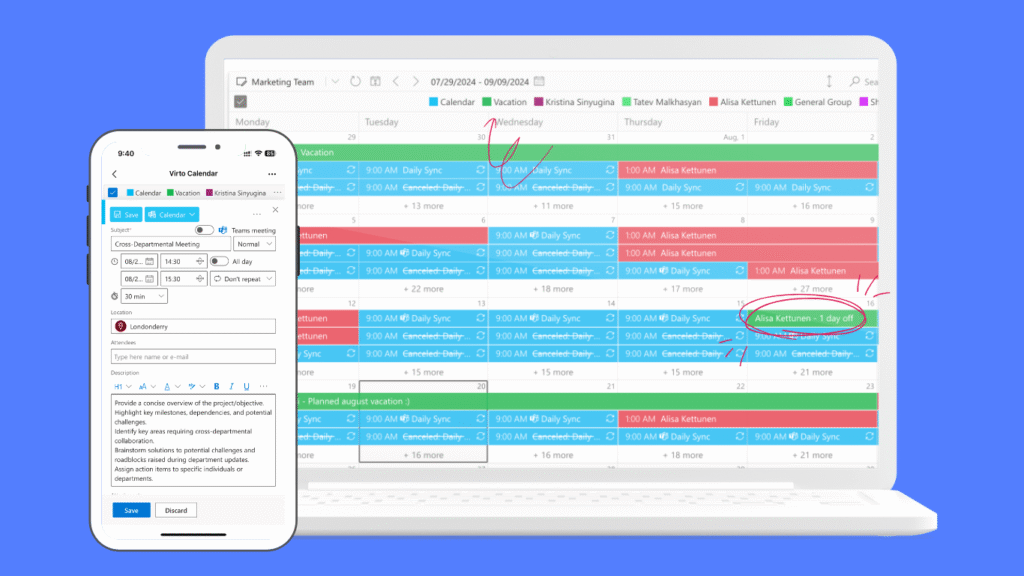
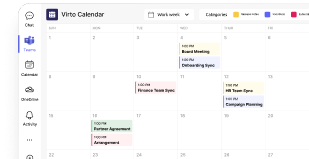
Pic. 8. Virto Calendar — multiple shared calendars overlaid in a single unified view.
Schedule a Virto Calendar demo • Start a free trial on AppSource
FAQ
Why is my shared Outlook calendar not showing up?
The three most common causes are a pending sharing invitation, an unticked calendar checkbox in your navigation pane, and insufficient permissions (below Reviewer). In 2025/2026 builds of Classic Outlook for Windows, the “Shared Calendar Improvements” toggle is also a frequent culprit. Work through Fixes 1–4 above in order.
How do I fix shared calendar not showing in Outlook?
Start with the 30-second diagnostic table to match your symptom to the right fix. The two highest-yield checks are (1) confirm the calendar is checked in your navigation pane (Fix 2) and (2) disable the Shared Calendar Improvements toggle if you’re on Classic Outlook for Windows (Fix 4). Together these resolve most cases.
What is the Shared Calendar Improvements toggle in Outlook?
It’s a setting introduced by Microsoft in 2024–2025 that changes how Classic Outlook for Windows syncs shared calendars (from MAPI to REST). Microsoft enabled it by default, but it causes shared calendars to disappear in some configurations. To disable it: File → Account Settings → Account Settings → select your account → Change → More Settings → Advanced → uncheck “Turn on shared calendar improvements.”
Why can’t I see someone’s calendar in Outlook even after they shared it?
Either the invitation hasn’t been accepted (check your inbox and Spam/Junk), the calendar checkbox is unticked in your navigation pane, or your permission level is below Reviewer. Less commonly, an Exchange Online sharing policy is blocking visibility — escalate to your IT admin if user-side fixes don’t resolve it.
How do I add a shared calendar in New Outlook?
In New Outlook, go to the Calendar view, click “Add calendar” in the left pane, then choose “Add from directory.” Search by the owner’s name or email, select them, and click “Add.” The calendar appears under “Other people’s calendars.” This is different from Classic Outlook, where you would go through File → Account Settings.
What permissions do I need to view a shared Outlook calendar?
At minimum, “Reviewer” — read-only access to all event details. Lower levels like “Free/Busy time” or “Limited details” show the calendar’s existence but hide event titles and bodies. For editing access, ask the owner for “Author” or “Editor” permissions.
Merge all calendars in one place
Try Virto Calendar to Sync all events in Teams
To deepen your understanding of Outlook calendars and troubleshooting, here are some valuable resources:
Official Microsoft Resources:
- Shared Calendars Not Visible in New Outlook
- Shared Calendars Not Visible in Outlook Desktop
- Fixing Issues with Shared Calendars Not Showing
- Events Not Showing in Shared Calendar
- Unable to View Shared Calendar List View
Our Blog Articles: